
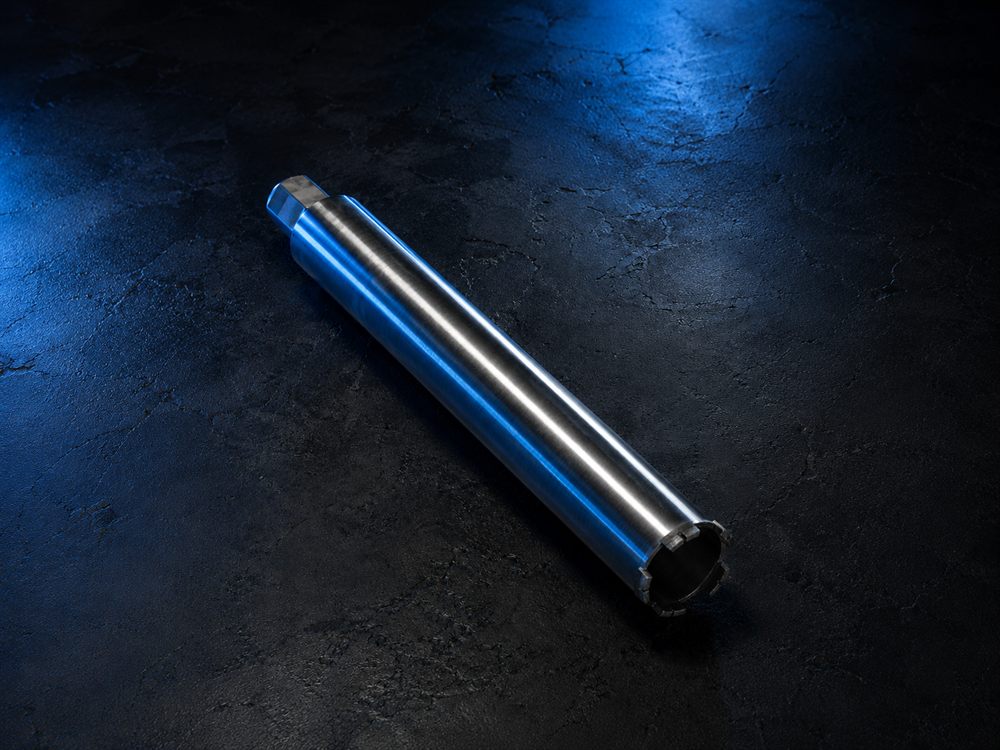
A jobsite decision guide for concrete and other aggregate, dust control, slurry and proper tool compatibility.
Wet versus dry core drilling or cutting is not a simple quality ranking. Wet coring or cutting is usually the stronger starting point for sustained concrete work because water controls heat, carries cuttings, and suppresses dust. Dry coring or cutting can be the practical choice where water or slurry cannot be managed or in certain types of locations, but it requires a bit and machine approved for dry use plus an effective dust-control plan. The correct method depends on the material, reinforcement, hole or cutting size and depth, location, equipment, and exposure controls.
Wet vs dry core drilling and sawcutting at a glance
Scroll sideways to see all columns.
| Decision factor | Wet core drilling and cutting | Dry core drilling and cutting |
|---|---|---|
| Heat control | Continuous water removes heat at the segment | Relies on dry-rated segment design, airflow, extraction, and duty cycle |
| Dust and debris | Creates slurry that must be contained and collected | Creates airborne dust unless captured at the source |
| Typical fit | Sustained concrete coring or cutting,, deeper holes or depths of cut, larger diameters, when encountering reinforcement | Water-sensitive locations, many masonry tasks, and approved dry systems |
| Jobsite setup | Water source, GFCI protection as applicable, slurry control | Matched vacuum or dust extractor, shroud or collection interface, filter management |
| Tool requirement | Wet-rated motor and wet-use bit or blade | Dry-rated bit or blade and a machine approved for the application |
When wet core drilling or cutting is usually the better choice
Wet core drilling or cutting is commonly preferred for reinforced concrete, deeper penetrations, larger diameters, and repetitive production. Water cools the segment, helps carry cuttings out of the kerf, and supports dust control. Those benefits can improve consistency, but only when the equipment and tool, water delivery, anchoring, and electrical protections are set up correctly.
Wet drilling or cutting also creates a containment problem. Slurry can damage finishes, enter occupied areas, stain porous surfaces, or reach electrical and mechanical systems. Plan the collection method before drilling or cutting. Water rings, dams, wet vacuums, and controlled disposal may be required, depending on the site and local rules.
When dry core drilling or cutting makes sense
Dry drilling or cutting is useful when water is prohibited, access to a water supply is poor, slurry would threaten finished spaces, or the material and cutting needs fall within a dry-rated system’s capability. It is often associated with brick, block, and other masonry applications, although some professional systems are engineered for dry drilling or cutting in concrete.
The key word is system. A dry core bit or blade is not simply a wet bit or blade used without water. Segment bond, geometry, barrel ventilation, connection, drill speed, dust extraction, and allowable duty cycle must work together. Product instructions determine what is permitted.
Can you dry core drill or saw cut concrete?
Yes, but only with equipment and tooling specifically rated for the concrete, diameter, depth, and drilling mode. Dense aggregate and reinforcement increase heat and load. Some dry core drilling systems use specialized segment designs or controlled micro-impact; ordinary bits should not be placed in impact mode unless both the drill and bit are explicitly designed for it.
If the job involves heavily reinforced concrete, a long penetration, a large diameter, or repeated holes, wet coring or cutting is often the more forgiving baseline. When dry coring or cutting is necessary, confirm the system limits before arriving on site rather than treating the first hole as a test.
Dust control is part of the method selection
Concrete and masonry drilling or cutting can release respirable crystalline silica. In the United States, OSHA’s construction silica standard includes specified controls for handheld and stand-mounted drills and saws. For covered rig-mounted core saws or drills, OSHA Table 1 specifies an integrated water-delivery system at the cutting surface; for covered handheld power saws, it specifies integrated water delivery to the blade. The shroud and dust-collection entry applies to handheld and stand-mounted drills, including impact and rotary hammer drills. If a different method is used for a covered task, the employer must assess and limit exposure under paragraph (d), as applicable. Exposure duration, if the work is indoor or in an enclosed place, and employer respiratory-protection obligations can change the requirements.
Do not select wet or dry drilling on convenience alone. The competent person or safety lead should verify the applicable OSHA table entry, equipment instructions, exposure-control plan, and site rules. Water suppresses dust but does not eliminate every hazard; dry extraction must capture dust at the source and be maintained as designed.
A practical method selection checklist
- Identify the base material and expected reinforcement. Concrete, reinforced concrete, brick, block, asphalt, stone, and tile do not impose the same demands.
- Define the hole or cut. Record diameter, depth, orientation, number of holes or cuts, edge distance, and whether the opening is through-drilled or cut or blind.
- Check the environment. Note occupied areas, finished surfaces, overhead work, drainage limits, water-sensitive equipment, and space for slurry or dust collection.
- Verify the machine and bit or blade as a system. Match the connection, diameter capacity, speed range, power, mounting method, drilling mode, and wet or dry rating.
- Choose the exposure control. Confirm the OSHA control route for the exact task, then the required water delivery or approved alternative controls, extractor, airflow, filter, and disposal process.
- Plan containment and cleanup. Decide where water, slurry, dust, and the debris like a core, will go before the work is started.
- Follow the most restrictive instructions. If the bit or blade, motor, accessory, site plan, or regulation prohibits the method, choose another system.
Common mistakes that shorten tool life
- Running a wet-only bit without water.
- Using an ordinary core bit in percussion or impact mode.
- Assuming a vacuum alone makes any dry setup compliant or safe.
- Using one speed setting across widely different diameters.
- Forcing a dry bit or blade continuously without the cooling pauses or duty cycle required by its manufacturer.
- Allowing wet slurry to recirculate without adequate removal of abrasive cuttings.
- Ignoring alignment, anchoring, and reaction torque because the hole or cut appears small.
Frequently asked questions
Do wet core bits or blades last longer than dry ones?
They often have a thermal and flushing advantage in sustained concrete work, but service life depends on the material, segment specification, speed, feed, alignment, water delivery, and operator technique. A mismatched wet bit or blade can still perform poorly.
Can the same core bit or blade be used wet and dry
Only if the manufacturer explicitly rates that exact bit or blade for both methods. Do not assume the methods are interchangeable.
Is dry coring or cutting cleaner than wet coring
Dry coring or cutting avoids slurry, but it is clean only when dust is captured effectively. Wet coring or cutting suppresses airborne dust but creates liquid waste that must be contained.
Choose the system before choosing the bit or blade.
Diamond Tool Exchange, DTX, can help narrow the options when you provide the material, reinforcement, dimensions, drill or saw model, connection, work location, water restrictions, and production volume. Those details determine whether wet or dry coring is realistic and which specifications should be checked before purchase.