
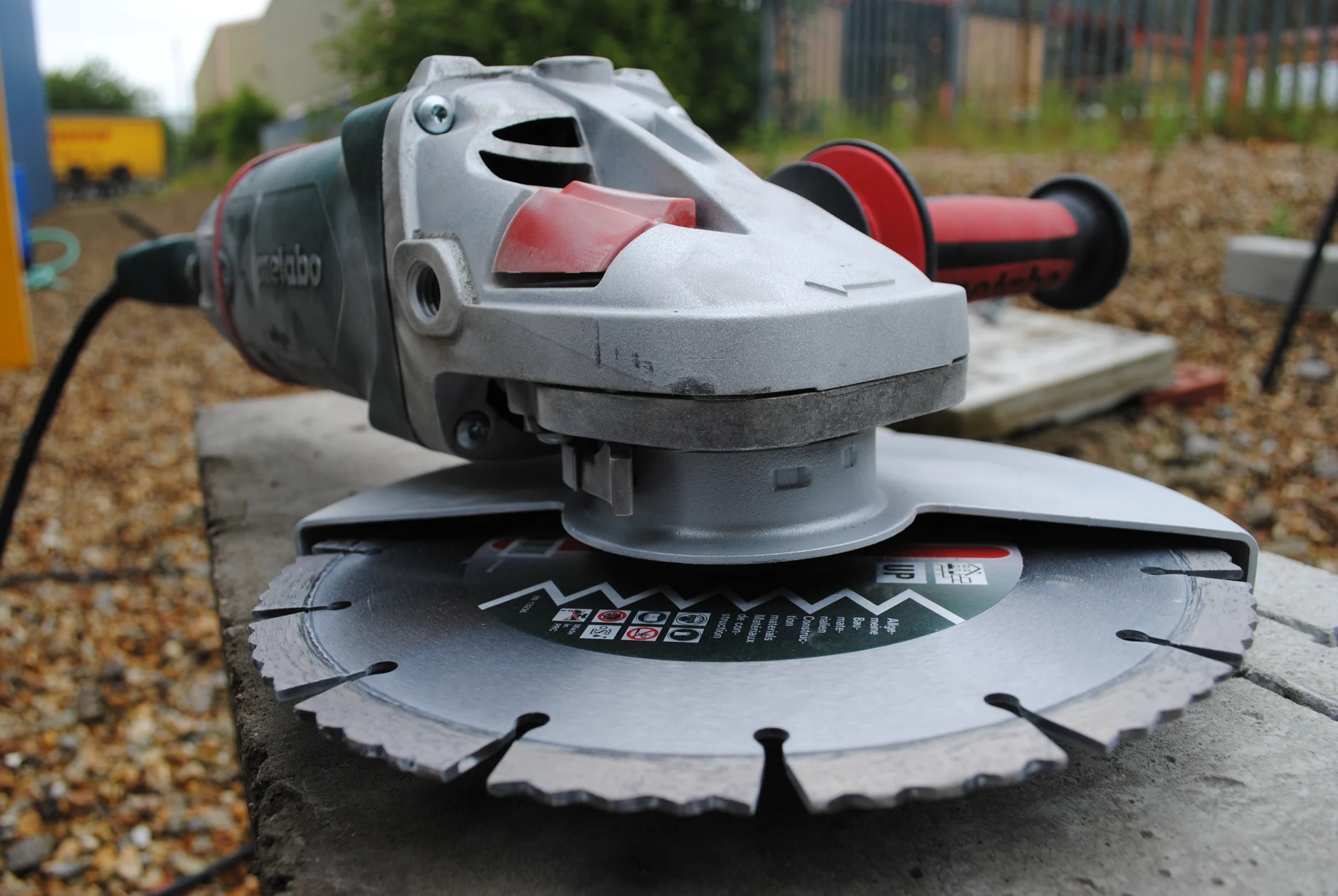

How aggregate hardness and abrasiveness change blade selection, cutting behavior, and wear
The basic rule for soft bond vs hard bond diamond blade selection is deliberately opposite the material. That is, hard, dense, non-abrasive material generally needs a softer bond, while soft or highly abrasive material generally needs a harder bond. The metal bond controls how quickly worn diamond is released and fresh diamond is exposed. It is not a simple quality grade, and 'harder bond' does not automatically mean a better or longer-lasting blade for every job. Use the manufacturer's application guidance to check the tool against your job and aggregate.
What the bond does in a diamond blade
A diamond segment contains industrial diamonds held in a metal matrix called, the “bond”. During cutting, exposed diamond fractures and dulls while the surrounding matrix wears. Productive cutting depends on those two processes staying in balance: the bond must hold useful diamonds in place long enough to work, then wear away fast enough to reveal fresh cutting diamonds.
If the matrix wears too slowly, the face can polish or glaze and the blade stops cutting freely. If it wears too quickly, usable diamond is released early and segment height disappears faster than necessary. Bond selection is therefore a very important, wear-rate decision, based on the job, the material, aggregate, saw type, cut, and if water is required.
Soft bond vs hard bond diamond blade selection
Scroll sideways to see all columns.
| Job condition | Starting bond direction | Why |
|---|---|---|
| Hard, dense, relatively non-abrasive aggregate | Softer bond | The matrix must wear readily enough to expose fresh diamond as cutting points dull |
| Soft, sandy, green, or otherwise abrasive material | Harder bond | The abrasive material already erodes the segment, so a wear-resistant matrix helps retain diamond |
| Asphalt or abrasive sub-base exposure | Harder abrasive-material specification, often with undercut protection | Abrasive fines can consume segments and attack the steel core below them |
| Mixed materials or uncertain aggregate | Supplier-selected general-purpose or medium range | A compromise can be practical, but it should be chosen from the full job details rather than the label alone |
| Frequent glazing with otherwise correct setup | Evaluate a softer bond | The existing matrix may not be wearing quickly enough for the material |
| Fast segment loss with otherwise correct setup | Evaluate a harder bond | The matrix may be wearing too quickly for the material's abrasiveness |
Material hardness and abrasiveness are not the same
Hardness describes resistance to being cut or scratched. Abrasiveness describes how aggressively the material and its fines wear the segment and steel core. They often point in different directions. Hard aggregate may dull exposed diamond without wearing much matrix, which favors a softer bond. Softer, sandy material may cut easily yet scour the matrix quickly, which favors a harder bond.
Concrete is especially variable because sand, coarse aggregate, cure age, reinforcement, and sub-base all influence the cut. A blade that works well in one region or pour may behave differently in another. That is why blade selection should account for aggregate and job conditions instead of treating every 'concrete blade' the same way.
Signs the bond may be too hard
- The blade initially cuts, then slows while substantial segment height remains.
- The segment face looks smooth or polished instead of actively cutting.
- Heat and cutting pressure rise as the operator tries to maintain progress.
- Dressing restores cutting temporarily, but the blade repeatedly glazes in the same material.
The blade bounces on the cutting surface.
These symptoms do not prove a bond mismatch by themselves. Low power, incorrect RPM, poor cooling, shallow horsepower, a damaged saw, wrong mounting direction and incorrect rotation, or excessive reinforcement can also reduce performance. Correct the setup before changing specifications.
Signs the bond may be too soft
- Segment height drops rapidly even though the blade continues to cut freely.
- Wear is much faster in abrasive material or when the blade enters the sub-base.
- The steel core begins to undercut directly below the segments.
- Blade cost per cut rises because the matrix releases diamond before its useful cutting life is exhausted.
Rapid wear can also come from insufficient water, excessive feed, an out-of-round saw, misalignment, the wrong blade diameter or speed, or a blade designed for a different application. Diagnose the system rather than judging bond from one symptom.
Information to give the blade supplier
- Exact material or materials. i.e. cured concrete, green concrete, asphalt, brick, block, paver, stone, or a layered combination.
- Aggregate and abrasiveness: rock type or local aggregate information when known, plus whether the concrete is sandy, hard, dense, or unusually abrasive.
- Reinforcement: none, light, heavy, mesh, or unknown. Do not cut post-tension or embedded utilities without the required authorization and controls.
- Saw details: manufacturer and model, blade diameter, arbor and drive-pin arrangement, available power, approved RPM range, and handheld, masonry-saw, wall-saw, or flat-saw use.
- Cut details: depth, length, plunge or continuous cut, entry into sub-base, production volume, and whether the work can stay straight and supported.
- Cooling and dust control: wet or dry operation permitted by the blade and saw, available water delivery, and the jobsite's silica-control plan.
- Priority: fastest production, lowest cost per cut, longest life, cleanest edge, or a balanced general-purpose result.
How bond choice affects purchasing
A universal blade can be useful when crews encounter mixed work, but universality is a tradeoff, not proof that one specification is optimal everywhere. For repeat production in known material, an application-specific bond can reduce glazing, premature wear, and trial-and-error. The purchase decision should also confirm size, arbor, rotation, maximum speed, wet or dry rating, segment condition, and the saw manufacturer's requirements.
Bond labels are not necessarily standardized across manufacturers. One brand's 'soft' or application code should not be translated directly into another brand's catalog without the maker or supplier's cross-reference. Ask for a product recommendation tied to the actual material and machine, and keep job records so a successful specification can be repeated. Use the manufacturer's application guidance for your particular job and/or aggregate.
Frequently asked questions
Do hard materials need a hard-bond blade?
Usually the opposite. Hard, relatively non-abrasive material generally needs a softer bond so the matrix can expose fresh diamond. The complete application still matters, so use the manufacturer's selection guidance.
Is a hard bond always longer lasting?
No. A hard bond resists wear, but in hard material it may glaze, build heat, and stop cutting productively. Blade life is useful only when the blade can cut safely and efficiently and is more importantly, matched up to the job and aggregate correctly.
Can I tell aggregate hardness from the concrete surface?
Not reliably. Surface appearance may not represent the coarse aggregate throughout the slab. Project records, local aggregate knowledge, a tooling supplier's regional experience, and observed performance from a controlled trial are better inputs.
Should I dress a blade or change the bond?
Dressing can reopen a glazed blade when the manufacturer allows it. If the blade repeatedly glazes after speed, feed, power, cooling, and saw condition are corrected, the application may need a softer bond rather than repeated dressing.