
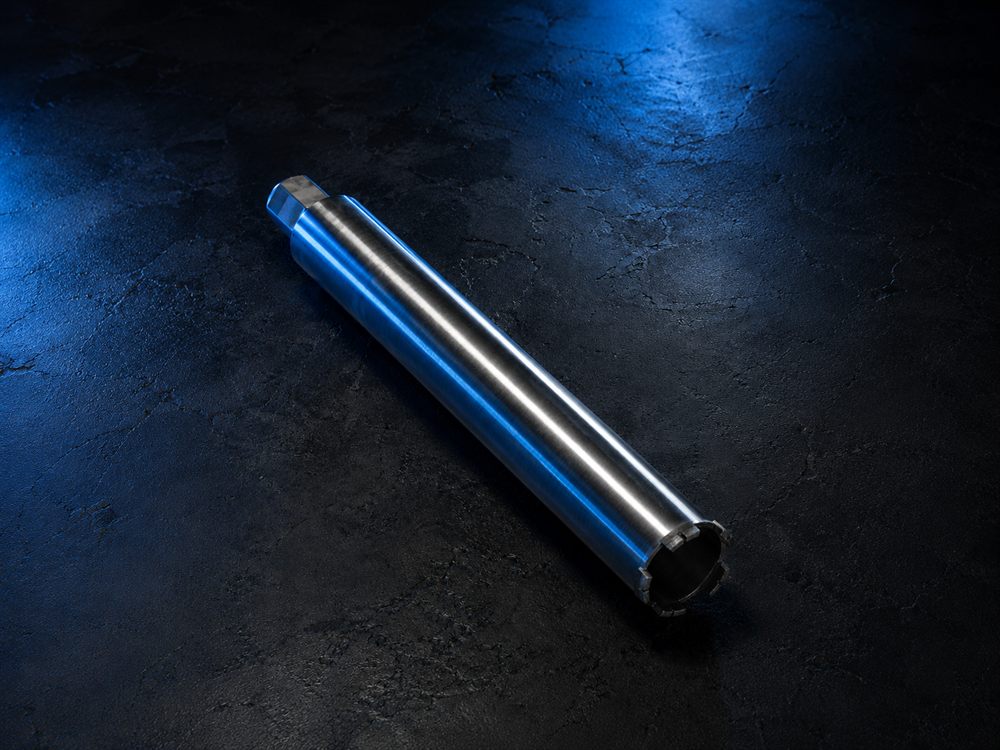
A practical decision guide for identifying the jam, releasing approved systems, and knowing when to stop
The safe answer to how to remove a stuck core bit from concrete is to stop the drill, isolate all energy, stabilize the rig and work area, and determine what is actually jammed before applying force. A barrel stuck in the hole, a concrete core wedged inside the barrel, and a seized threaded connection are all different failures with different causes. Use only the removal points and procedures approved for that exact core bit and drill system. If a core bit is caught on reinforcement, a utility, or a structural element, stop and escalate the job.
First identify what is stuck
Scroll sideways to see all columns.
| What moves | What may be happening | Safe next check |
|---|---|---|
| Motor and spindle stop, and the barrel will not rotate | The barrel may be side-loaded, packed with debris, pinched by the core, or caught on reinforcement | Isolate power and inspect the rig, hole, and accessible barrel before attempting manual release |
| Barrel rotates manually but will not withdraw | A core fragment or packed slurry may be wedging the barrel | Clear only accessible debris with the system entirely shut down and use the maker-approved extraction method |
| Motor can be removed but the barrel stays in the hole | The barrel may need its wrench flats, removal module, or a specified extractor | Consult the bit system instructions; do not clamp or crush an unapproved part of the barrel |
| Bit is out of the hole but the concrete core is stuck inside | The core may be tapered, fractured, reinforced, or jammed by slurry | Move the bit to a controlled work area and follow the maker's core-removal procedure |
| Barrel is free, but the threaded connection will not loosen | Threads may be overtightened, dirty, corroded, or loaded | Use the specified wrench flats and service procedure; do not use the motor as a holding fixture unless the manual allows it |
Why a diamond core bit gets stuck in concrete
A loose or fractured core wedges the barrel
The cylindrical core can fracture or shift before it is fully removed. A wedge-shaped piece may press against the inside of the barrel, especially near a breakthrough or when the hole crosses a change in material. Pulling harder can tighten the wedge rather than release it.
Slurry and cuttings stop clearing
Water carries cuttings out of a wet-drilled hole. If flow is blocked, interrupted, or poorly matched to the setup, slurry can pack around the barrel or inside the cut. Dry drilling can also pack dust when vacuum extraction is inadequate. Restoring the control system is part of preventing a repeat, but water or air should not be introduced into a jammed setup until the operator has followed the drill and site safety procedure.
The rig moves or the barrel enters at an angle
A loose anchor, unstable vacuum base, deflected stand, or aggressive start can move the barrel off the original axis. The hole then side-loads the barrel. Continuing to power through the bind can damage the barrel, segments, spindle, stand, and/or base material.
Reinforcement or embedded material catches the bit
A bit can slow or bind as it contacts rebar, wire mesh or other embedded objects. Do not assume every obstruction is harmless reinforcement. Confirm the approved hole location and use GPR scanning, permits, drawings, and site controls required for the work to analyze. Never improvise around suspected electrical, post-tension, plumbing, gas, or structural hazards.
How to remove a stuck core bit from concrete
- Stop feeding immediately. Release operating pressure without trying to power through the bind, then switch the machine off and wait for all rotation to stop.
- Isolate energy. Disconnect power, shut down hydraulic or pneumatic power, and follow the manufacturer's lockout procedure. Manage water and slurry so they do not create electrical, slip, or contamination hazards.
- Stabilize the rig and the work zone. Keep the stand anchored as the manual requires. Support any overhead or falling core, and control the opposite side of a through-hole. Do not work beneath an unsupported core or barrel.
- Inspect before applying tools. Look specifically for rig movement, a barrel that is visibly cocked, exposed rebar, a blocked water path, packed slurry, barrel damage, and whether the core is still attached. Record the bit and drill model so the correct instructions can be used.
- Separate components only where the system allows. Some systems let the motor, connection end, or module detach while the barrel remains in the hole.
- Use the approved manual release point. If the manufacturer permits it, use the correct wrench flats or extractor to relieve the bind with controlled manual rotation. Do not grab a thin barrel with pipe wrenches, hammer the segment rim, use heat, or energize the drill in reverse unless the manufacturer specifically instructs it.
- Stop if controlled movement does not release the bit. A barrel caught on reinforcement, badly side-loaded, damaged, or inaccessible may require a qualified core-drilling technician or manufacturer support. More force is not a diagnosis.
- After removal, inspect the full assembly. Check the barrel, segments, hub, threads, spindle, stand, anchor or vacuum base, water delivery, and hole condition. Replace damaged components and correct the cause before restarting.
A note on specialty extraction methods
Some diamond-tool suppliers document a threaded-rod method that pushes against the concrete through a compatible hub to dislodge a stuck core. That is not a universal procedure. Thread size, hub design, load path, access, and the cause of the jam all matter. Use it only when the bit manufacturer or qualified supplier confirms the method for the exact assembly and the site can control the resulting load and core movement.
How to keep the next core bit from binding
- Verify the hole location and scan for embedded hazards according to the job plan before drilling.
- Anchor and align the stand as the drill manufacturer specifies. Recheck the base if the cut sound, feed feel, or water return changes.
- Match the bit, connection, diameter, speed range, and drilling method to the machine and material.
- Maintain the approved water flow or dust extraction so cuttings leave the kerf(cutting area) instead of packing around the barrel.
- Use steady feed rather than forcing the bit. Back off at the first sign of binding, unusual vibration, stand movement, or a sudden change in motor load.
- Plan core removal on deep holes and manage breakthrough so a loose core cannot fall, wedge, or damage work below.
- Keep threads and specified wrench flats clean, and use only manufacturer-approved adapters, anti-seize practices, and tightening methods.
Frequently asked questions
Should I run the drill in reverse to free a stuck core bit?
Only if the exact drill and bit instructions authorize powered reverse for that situation. Many jams involve side load, a loose core, or reinforcement; reversing under power can worsen damage or unthread components unexpectedly. Be sure to check with the manufacturer before attempting any reverse drilling.
Can I hit the barrel with a hammer?
Do not strike the segment rim or beat on the barrel as a general removal method. Impact can deform the barrel, crack segments, damage joints, or release the core unpredictably. Follow the approved service points and extraction method.
When should I call a core-drilling specialist?
Escalate when the bit may be caught on reinforcement or an unknown embedded object, the rig or barrel is damaged, the hole is overhead or otherwise difficult to control, the approved release procedure fails, or the work affects a structural or utility-sensitive area.