
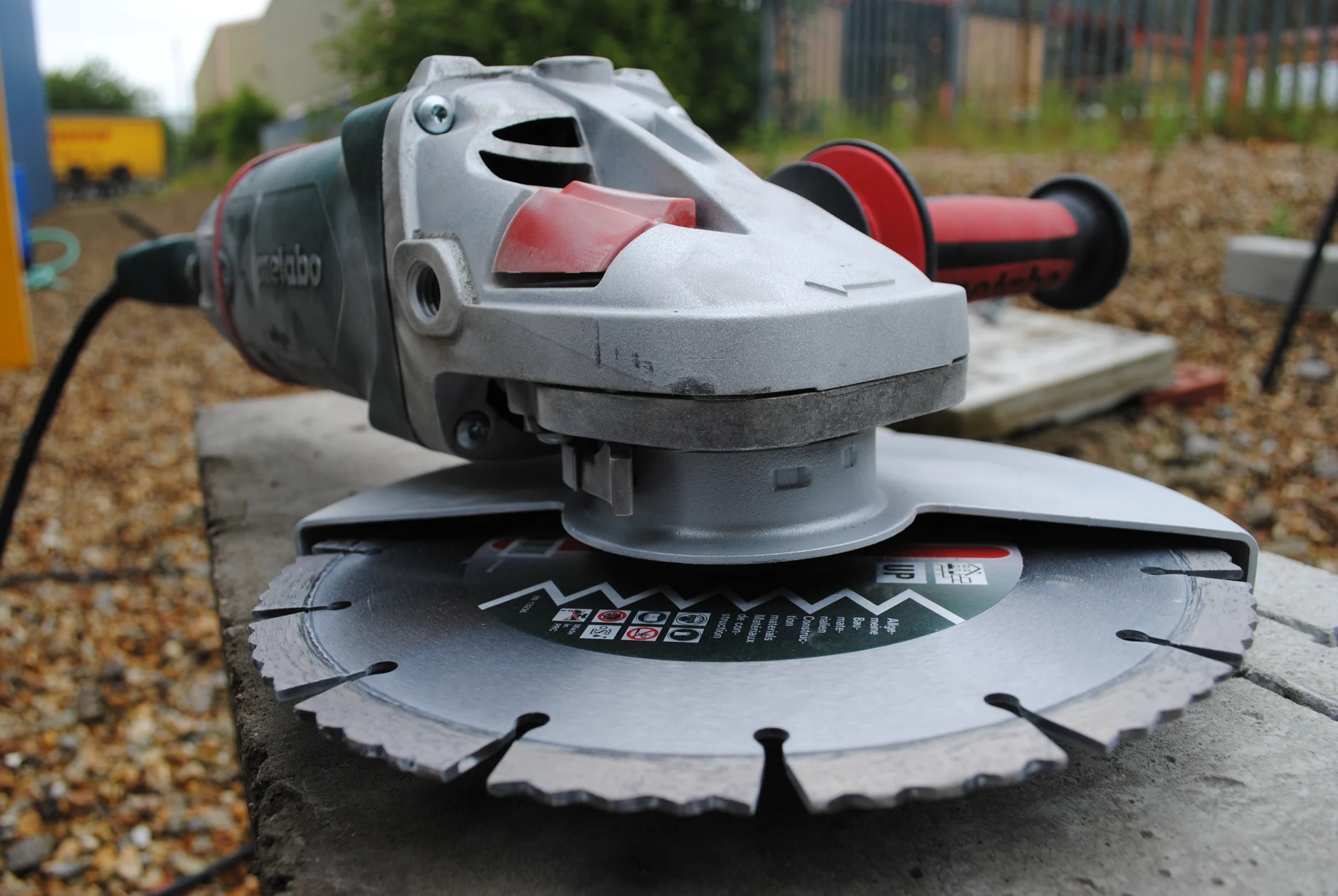

Understand what blade construction terms mean before using them.
Laser welded vs brazed diamond blades describes how diamonds or diamond bearing segments are attached, but the wording is easy to misread. A laser welded blade usually has segments welded to a steel core. Brazed can describe segments joined to the core with a filler metal or diamond grit brazed onto a cutting surface. The construction method matters, yet the exact material rating, saw, speed, and wet or dry instructions remain the deciding factors on which is best for your job and materials.
Laser welded vs brazed diamond blades in plain language
Scroll sideways to see all columns.
| Term on the product | What it may describe | What it does not prove |
|---|---|---|
| Laser welded | Diamond bearing segments are metallurgically welded to a separate steel core using a laser. | That the blade fits every saw, can cut every material, or is always approved for dry use. |
| Silver brazed segment | A diamond bearing segment is joined to the steel core using a brazing alloy that is soldered on. | That all brazed blades share the same temperature limit, segment design, or wet use requirement. |
| Vacuum brazed | Diamond grit is bonded to a surface in a vacuum brazing process; on some designs that component is then attached to a core. | That vacuum brazed and laser welded are mutually exclusive descriptions. |
| Sintered | Diamond and metal powders are consolidated into a segment or, on some blades, the rim and core are produced as one assembly. | That every sintered product has the same application, quality level, or attachment method. |
Diamonds can be attached using vacuum brazing, sintering, or laser welding. Product literature shows why buyers must read the complete construction description
What laser welding changes
Laser welding creates the joint between a separately manufactured segment and the steel core. Manufacturers use it on many demanding concrete, masonry, asphalt, and general purpose blades because the segment attachment can tolerate the loads and heat expected in those approved applications.
Do not turn that construction detail into a blanket operating rule. A laser welded joint does not make the segment bond correct for every material, and it does not automatically authorize dry cutting. Water, cooling intervals, equipment power, speed, and application remain product specific.
What brazing can mean
Brazing joins materials using a filler metal without melting the base parts in the same way as a welded joint. In diamond tooling, the word can appear in at least two buyer relevant contexts. A segment may be brazed to a steel core, or individual diamond grit may be vacuum brazed to a cutting surface.
That distinction affects how the product is described and its intended used. A vacuum brazed multipurpose blade may look and perform differently from a conventional segmented blade whose segments were attached with a brazing alloy. The label and technical data should state the approved material or materials, and operating method. The single word “brazed” is not enough for selection.
Choose by the application before the joining method
- Identify the material precisely, including cured or green concrete, reinforcement, asphalt, brick, block, stone, tile, or mixed demolition material.
- Confirm the saw type, blade diameter, arbor, guard, maximum operating speed, available power, and approved cutting orientation.
- Read the exact blade's material icons or written application. Do not infer suitability from laser welded, brazed, segmented, or multipurpose language alone.
- Verify wet only, dry capable, or wet/dry instructions. Follow the more restrictive requirement from the blade and saw documentation.
- Compare job priorities such as cut volume, finish, depth consistency, changeover time, and total cost under similar conditions.
- Inspect the blade before use and remove it from service for cracks, loose or missing segments, core distortion, a damaged arbor, or other retirement conditions as indicated in manufacturer literature.
Common buying mistakes
- Assuming laser welded means “premium” for every job. A well made blade can still be wrong for the material, saw, or finish requirement one is dealing with.
- Assuming every brazed blade must be used the same way. Brazed segment attachment and vacuum brazed grit describe different constructions.
- Treating a joining method as a wet/dry rating. Use only the operating method printed for the exact product.
- Ignoring the segment bond and material specification. The joint holds the cutting section to the core; it does not determine the full cutting behavior by itself.
- Comparing price without comparing application and production. A low purchase price is a poor value if the blade does not safely complete the intended work.
A label check before purchase
Before buying, collect the full product name or part number, diameter, arbor, maximum RPM, material rating, wet or dry instruction, rim or segment design, and approved equipment. If the construction description is ambiguous, ask the seller or manufacturer to clarify what is brazed, what is laser-welded, and how that affects the stated use. Do not accept an unsupported claim that one attachment method is universally safer, faster, or longer lasting.
Frequently asked questions
Are laser welded diamond blades always better
No. Laser welding can provide a strong segment to core joint, but the best blade is the one whose complete specification matches the material, saw, method, and job priorities.
Can a brazed diamond blade be used dry
Only if the exact blade is labeled and documented for dry use. The word brazed alone does not establish the cooling requirement.
Can a blade be both vacuum brazed and laser welded
Yes. A manufacturer may vacuum braze diamond grit onto a segment or cutting component and laser weld that component to a steel core. Read which part of the construction each term describes.