

Use the rotation arrows and machine manual instead of guessing from the label.
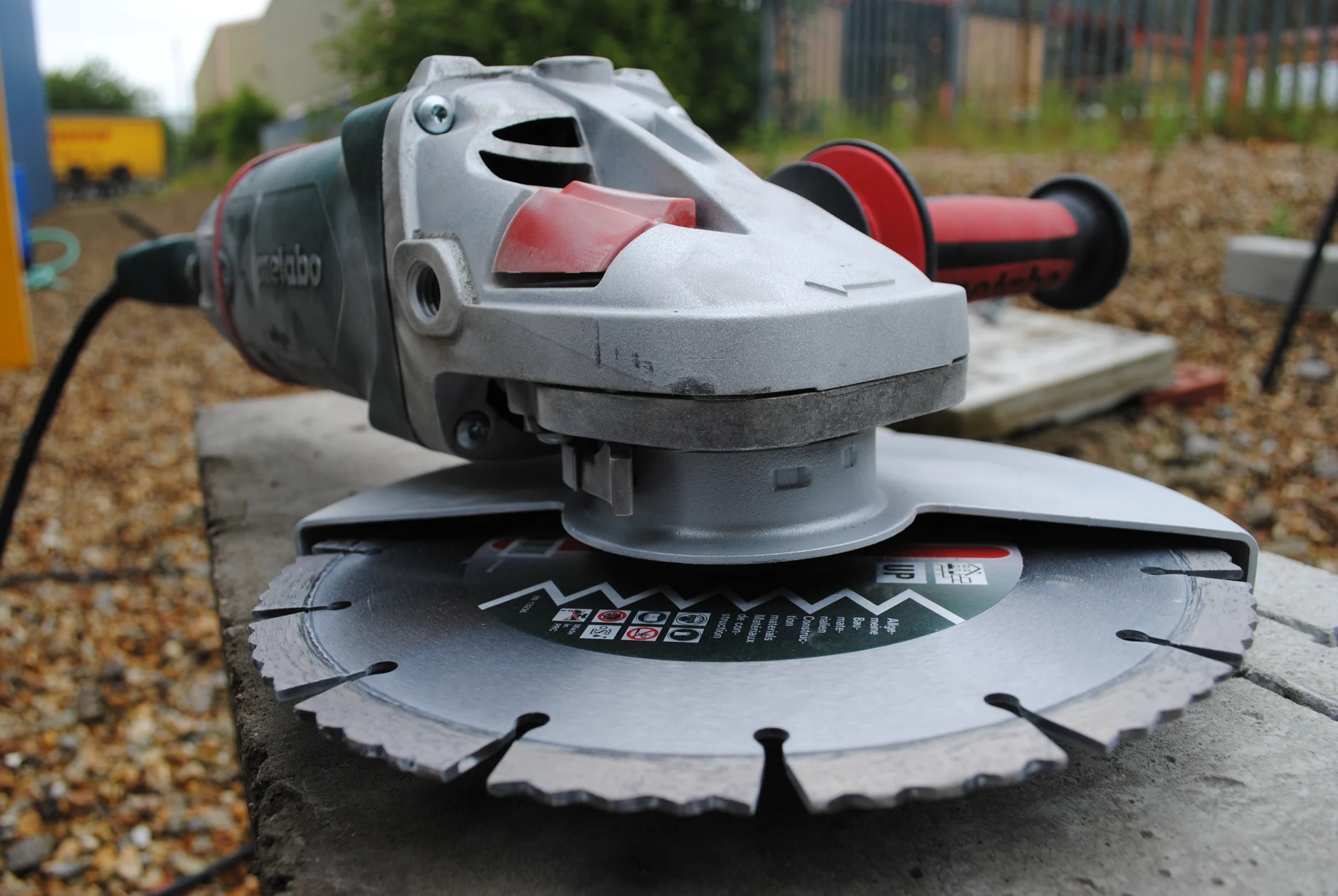
Which way does a diamond blade go on a concrete saw? Install it so the rotation arrow on the blade points in the same direction as the rotation arrow on the saw or blade guard. Do not use the printed label as the deciding reference. Depending on the machine and blade, the label may face inward or outward when the arrows are correctly aligned.
Which way does a diamond blade go on?
Start with the machine isolated from power and the blade fully stopped. Find the directional arrow etched, stamped, or printed on the blade's steel core. Then find the rotation arrow on the saw, usually near the guard or spindle. When the blade is mounted, those arrows should describe the same direction of travel.
Manufacturers’ saws’ instructions tell operators to make sure a diamond blade rotates in the direction shown by the arrow on the blade. These instructions are model specific, so the exact saw manual remains the controlling source.
Why label side is not a reliable rule
The label is designed for identification, not as a universal mounting standard. Saw layouts differ, and some machines can be configured with the blade on a different side. A blade can therefore be correctly installed with its label facing the operator on one saw and facing the machine on another. The rotation arrows, arbor fit, flanges, and manual determine the installation.
Scroll sideways to see all columns.
| What to inspect | Correct check | Do not assume |
|---|---|---|
| Rotation arrow | Blade arrow and machine arrow indicate the same direction. | The label always faces out. |
| Arbor and bushing | The blade bore fits the approved spindle or manufacturer-approved bushing. | A loose adapter or improvised reducer is acceptable. |
| Flanges | Both contact faces are clean, flat, undamaged, and installed as the manual shows. | Tightening harder corrects dirt, burrs, or the wrong flange. |
| Maximum speed | The blade rating meets or exceeds the saw's operating speed. | Matching diameter alone makes the blade compatible. |
| Blade guard | The correct guard is installed and adjusted before operation. | The guard can be removed to see the arrow or gain depth. |
A safe blade installation sequence
- Shut down and isolate the machine according to its manual. Remove the battery, unplug the cord, or prevent engine starting before touching the blade.
- Confirm that the replacement blade matches the saw type, approved diameter, arbor, maximum speed, material, and if it is a wet or dry method.
- Inspect the blade for cracks, distortion, damaged segments, a damaged bore, or other defects. Do not mount a questionable blade.
- Clean and inspect the spindle, inner flange, outer flange, and approved bushing. Replace damaged mounting parts rather than forcing the blade to fit.
- Align the blade's rotation arrow with the machine's rotation arrow. Seat the blade flat against the inner flange without side pressure.
- Install the outer flange and fastener exactly as the manual specifies. Use the stated tightening procedure rather than an impact wrench unless the manufacturer expressly permits one.
- Rotate the blade by hand only when the machine is safely isolated and the manual allows it. Confirm clearance, refit or close the guard, and complete the required pre-use inspection.
What if the arrow is missing or unreadable
Do not guess from the label, segment shape, or online photos. Identify the blade by its product markings and check the manufacturer's current instructions. If the product cannot be identified or its direction cannot be confirmed, remove it from service and replace it with a blade whose rating and orientation are clear.
Some experienced users examine wear patterns to infer previous rotation, but that is not a substitute for verified product instructions. A used blade may also have damage, uneven wear, or an uncertain history that makes remounting it a poor decision.
What happens if a diamond blade runs backward
The outcome depends on the blade construction and equipment, but manufacturers warn that incorrect rotation can dull the blade quickly and reduce cutting performance. Stop the machine if the blade cuts unusually slowly, heats, wanders, vibrates, or sounds different. Isolate the saw and recheck direction, mounting surfaces, blade condition, material match, water delivery, and machine condition before continuing.
Reversing the blade is not a general sharpening method. Follow the exact blade maker's guidance for dressing or restoring a glazed blade, and never use a dressing procedure that conflicts with the saw or blade rating.
Frequently asked questions
Should the diamond blade label face in or out
Either orientation may occur. Match the blade's rotation arrow to the machine's rotation arrow and follow the exact saw manual.
Can I flip a diamond blade over
Only if the manufacturer permits the installation and the direction arrow still matches machine rotation. Do not flip a blade to solve uneven wear without diagnosing the cause.
Does the arrow matter on every diamond blade
Treat the marked arrow as mandatory. If the manufacturer marks a direction, install and operate the blade in that direction.